















Find useful information
Recently active
@Peter Anderton Hi Peter, the images in the latest release notes seem to be broken.Could you pls have a look?
I’m making a start on learning and setting up the universal access portal, hopefully using the new interface (not WordPress). I’m trying to find information to help me on this journey but I cannot find anything and hoping someone can point me to the best guidance resources to refer to.
Dear Community,My name is Martyn Simpson, and I am the new Chief Information Security Officer at Preservica. I am delighted to be part an amazing organization, ensuring that the information you entrust to our platform remains secure. Myself, and the Information Security Team have been working hard on our Information Security Governance, Risk Management, Compliance, Security Operations and ensuring transparency to our clients of the security controls we have in place.We understandably receive a lot of questions from you, our customers as to how Preservica is taking appropriate action for the protection and confidentiality of client data as a cloud service provider. In this newly released paper ‘PRESERVICA SHARED RESPONSIBILITY MODEL’ we’ve detailed the responsibilities that are applicable across our whole service offering but are specifically written in the context of Preservica Cloud. Shared Responsibility Model Please do also check out the rest of our newly launched Trust Center for
One of the objectives of the Safeguarding the Nation's Digital Memory project which produced DiAGRAM was to help archivists (in particular) make the case for digital preservation work. Part of this is having a built in benchmark model to help demonstrate the difference between merely backing-up material and actually doing digital preservation. If you’ve not explored the model yet, you can find the current (prototype) version at https://nationalarchives.shinyapps.io/DiAGRAM/I’m happy to advise on using the modelling to help you make a business case.
Britni Gorman, Deputy Archivist at the City of Providence, has been using Starter since August 2021. Since then, she has been able to save time and improve the experience for title researchers when it comes to responding to common requests for grantor and grantee index records. In this video she shows us how she is leveraging Starter to help title researchers work more efficiently with online self-service. Researchers can now navigate and find the entries they need in digital copies of indexes which stretch back as far as 1637. In turn this has reduced the need for information requests to be managed directly by the archives office. Not only are these important public records protected and preserved in Starter but they are also now accessible online. Watch this short video to see how Britni is using Starter. Why not try it for yourself? Download this simple guide to help you get started.
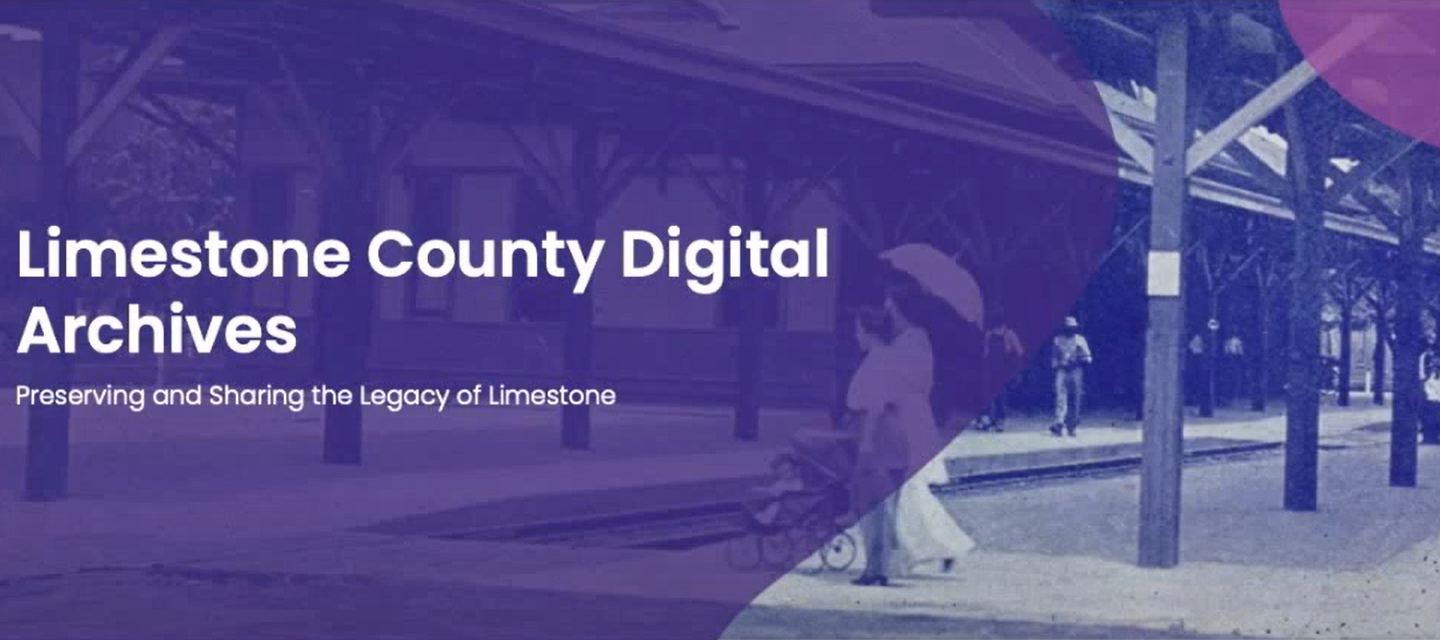
Archives are treasure troves, full of rich pieces of history. However, the variety of materials can make accessibility a challenge. In this video, Rebekah Davis, Archivist at the Limestone County Archives in Athens, Alabama shows how she’s able to overcome this challenge and preserve and share the legacy of her county with her community. You’ll learn how leveraging automated workflows and an integrated portal in Starter, enables the community members of Limestone County to self-serve and find the content that they need.Rebekah shares how this accessibility has unlocked major visibility for the archive, including:How a local newspaper utilized the archive for historical articles How members of the community were able to provide feedback through crowdsourcing to improve the record
This week we travel to the state of Utah where Jim Kichas, Committee Chair for the Cottonwood Heights Historic Committee, shows us how he uses Preservica Starter to preserve and share digitized historical content. Starter enables Jim to future-proof the rich local history and bring it to life online for the benefit of the community. Watch his short demo, showcasing a digitized asset, to see how quickly you can upload and create collections, easily preserve and enrich content and share valuable digital materials online in just a few clicks. Why not try it for yourself? Download this simple guide to help you get started.
This week we welcome Christy Costlow, Archivist for Travis County in Austin, Texas. In this video she shows us her simple process for preserving historical digital collections and making them available online for the local community.Christy demonstrates, even with only a limited archival staff, how she can easily bring the images of elected officials to life for citizens and ensure the fundamental task of preserving digital materials is taken care of. Watch this short video to see how quickly this can be done using Preservica Starter. Why not try it for yourself? Download this simple guide to help you get started.
Nathanial Smith, Municipal Archivist and Records Manager at the Town of Concord, Massachusetts, shows us how he is able to quickly respond to scan on-demand requests for historical records using Preservica Starter. See his process for preserving digital surrogates of historical records and sharing them with the public and find out how he is able to:Quickly ingest, protect and preserve digital copies of scanned records in Starter Enrich them using out-of-the-box metadata schemas Make them accessible to the community online Why not try it for yourself? Download this simple guide and get started.
For elected officials, government agencies, and departments Twitter has become a go-to source to communicate and distribute press releases, speeches, statements, videos, images, and more. For the tweets that are considered permanent records or historically significant, the question becomes:How do you easily preserve a tweet forever?With Preservica Essentials and Enterprise editions local government organisations can now:Ensure Twitter records can be trusted and read in perpetuity Quickly find tweets and other related records types Capture social posts directly and save time Trust the integrity of every record Enable online transparency for public Twitter records Watch this short video to explore how you can capture and ensure your social media records are accessible forever. Download this simple guide or why not contact us to learn more.
A paper by Jack O’Sullivan, Jon Tilbury and Richard Smith published at iPRES 2021.Abstract - Digital information often relies on the interactions of multiple individual digital files, rather than being completely encapsulated in a single file. Where this happens, all necessary files should be considered to be part of the same Multi-Part digital object. This paper describes a data model for describing the format of such digital objects, or more specifically, the Multi-Part Representations of such objects. As with the identification of file formats, having a Representation Format like this enables us to determine which tools to use to undertake particular preservation actions for a Representation.Keywords - Format identification, data model, complex objects For more information go to https://files.sciconf.cn/upload/file/20211206/20211206163241_26411.pdf
The need to share large digital files is a common requirement when it comes to responding to research request for public records. Tina Ratcliff – County & Information Records Manager for the Montgomery County Records Center & Archives, Ohio is using Preservica Starter to transform how she preserves and shares public records. With Starter Tina can now:Quickly find, read, trust, and share different record types, via a single trusted repository, in response to research and public records requests saving time and effort Easily provide requestors with access to large case files, with thousands of pages, in minutes, and avoid the need to break up large files to send over email Provide an enhanced experience for requesters with simpler and clearer communications and ensuring the integrity of the record Watch this short video to see how easily Tina can perform this common task. Why not try it for yourself? Download this simple guide and get started.
A paper by Jack O’Sullivan and Jonathan Tilbury.Abstract - Using a case study of how Preservica software was used within the Preservation Action Registries initiative, this paper explores how the exchange of file format best practice across the whole digital preservation community, including between suppliers of competing systems, is leading to improved automation. The primary focus of this work is on enabling users without deep technical knowledge to avail themselves of these technologies, so they can focus on the organisation, curation and presentation of their collections. The paper also explores some of the unanswered questions regarding how this automation can be achieved and what part users who do have deep technical knowledge will play in this future.Keywords - PAR, migration, digital preservation, automation, registry, policy For more information go to https://www.henrystewartpublications.com/jdmm/v9.
A paper by Matthew Addis, Justin Simpson, Jon Tilbury, Jack O’Sullivan, Paul Stokes published at iPRES 2018.Abstract - Current digital preservation systems such as Archivematica and Preservica lack a common and consistent way to describe and execute preservation policies and actions at a technical level. Archivematica’s Format Policy Register (FPR) and Preservica’s Linked Data Registry (LDR) both define what tools and rules to use when doing digital preservation and whilst these two approaches aim to solve similar problems, they are not interoperable. There is no way to share technical information between the two solutions and for users to share their experience on what approaches to use in different contexts and why. This hinders implementation and execution of digital preservation in an interoperable way within the digital preservation community. This paper presents new work by Artefactual, Arkivum, Preservica and Jisc on how Preservation Action Registries (PAR) could be used to capt
A paper by Rory Blevins, Ismail Patel, Jack O'Sullivan, Ashley Hunter, Robert Sharpe,Pauline Sinclair published at iPRES 2013.Abstract - This paper describes a mechanism for improving the scalability of preservation actions on large linked archives, such as WARC and ARC files produced from the archiving of web sites. To enable accurate but efficient preservation actions, information on the files embedded within a container object, such as the file formats of the embedded files, are aggregated and recorded as properties of the container object. This occurs during the ingest of objects into the archiving system, specifically at the characterization stage when files are identified and validated. To ensure that the details of all embedded files are also recorded, nested archives are recursively unpacked and their contents characterized to identify all files in a package. Information about the embedded files is then stored as properties of the container object: this allows us to efficiently
A paper by Jack O'Sullivan and Jon Tilbury.Abstract - since the 1960s, digital preservation has transformed from a secondary activity at a select few cultural heritage organizations to a vital international effort with its own best practices, standards, and community. This keynote presentation and paper presents an overview of the changing scope of digital preservation, issues, and strategies for digital preservation in the cultural heritage community.Keywords - digital preservation, knowledge sharing, PAR For more information go to https://www.ingentaconnect.com/content/ist/ac/2020/00002020/00000001/art00003#.
A paper by Jonathan Tilbury, Remke Verdegem and Euan Cochrane published at iPRES 2019.Abstract – Digital Preservation places a strong emphasis on building communities to share experiences and develop solutions. Traditionally these communities were built on geographic or functional alignment or created through external grant funded research activities. As commercial Digital Preservation products have emerged vendors have created User Groups for their customers that seek to fulfil this function. Using the lessons of the 11-year history of the Preservica User Group, this paper explores how these User Groups function and compares this to studies of User Groups in other domains.Keywords – Community; COTS; User Group;Conference Topics – Collaboration: a Necessity, an Opportunity or a Luxury; Building Capacity, Capability and Community For more information go to https://osf.io/6tyba/.
A paper by Jack O'Sullivan Richard Smith Alan Gairey Kevin O'Farrell published at iPRES 2019.Abstract – a data model is an expression of how a system is intended to be used, and a statement of how it should interact with other systems. As part of the development of the latest version of Preservica, the underlying data model was significantly altered, informed by what went before and by reference to the experiences and best practices distilled into the PREMIS Data Dictionary. This paper reports on some of the key decisions made in the application of the PREMIS concepts to an extant digital preservation system.Keywords – PREMIS, Data Model, Digital Preservation SystemsConference Topics – The Cutting Edge: Technical Infrastructure and Implementation; Designing and Delivering Sustainable Digital Preservation. For more information go to https://osf.io/xgnce/.
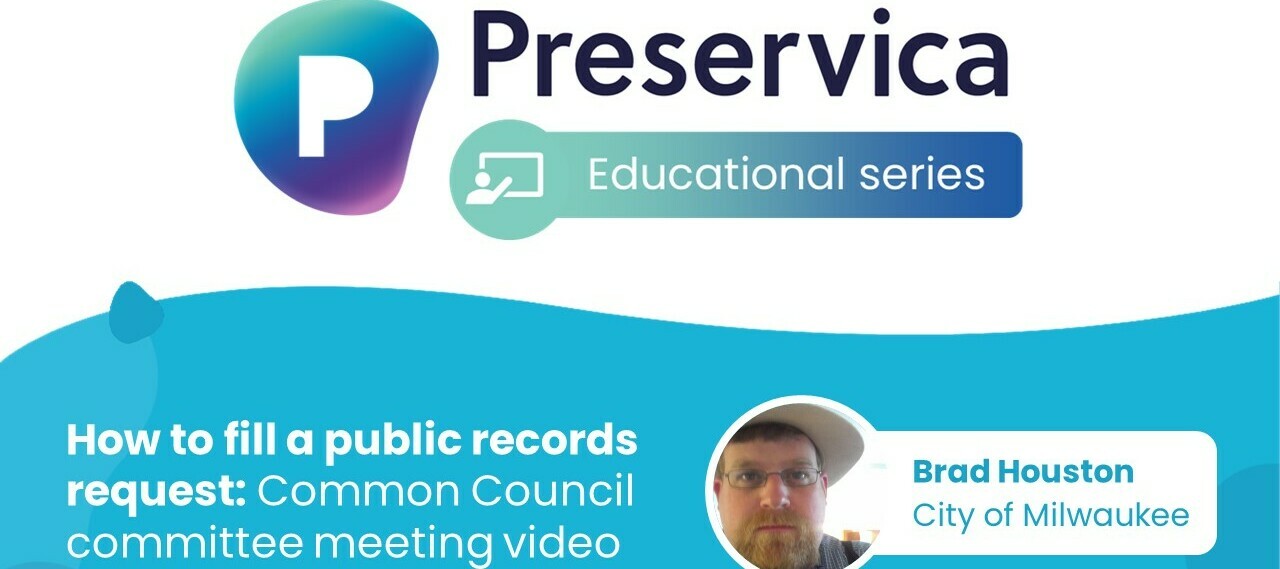
Sharing meeting minutes and videos are one of the ways that public sector employees meet compliance and open records regulations. A user from our Starter community, Brad Houston – Records Officer for the City of Milwaukee - walked us through his set up in Starter for an efficient way to respond to public records requests- using a Common Council meeting video as his example. Using Starter to preserve and share the video, Brad is able to:Offer a timely response to records requests Transfer files from dark storage Transform large complex legacy file formats with ease Digitally preserve permanent government records Provide access to citizens via an online public portal Brad covers the process in just a few minutes so please watch his walkthrough here: Why not try it for yourself? Download this simple guide and get started.
October is American Archives Month - the perfect time to celebrate and enhance public awareness of your online collections. American Archives Month is a collaborative effort by professional organizations and repositories around the nation to highlight the importance of records of enduring value. Are you celebrating American Archives Month? Please share how you’re celebrating in the comments. Or better yet, show off your portal! I’ll kick things off by sharing this great blog post from @Michael Hope that showcases some of his favorite online portals.
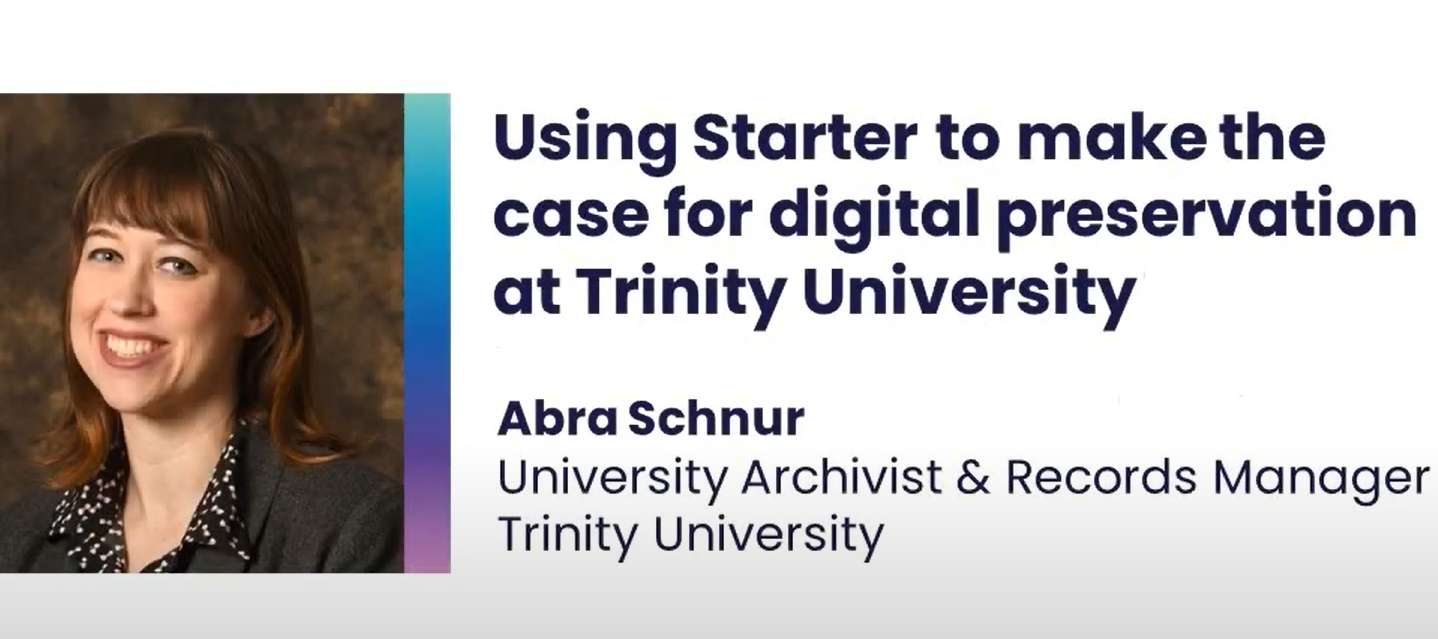
Hear from Abra Schnur, University Archivist and Records Manager at Trinity University as she shares her story, timeline and top-tips for successfully advocating for digital preservation at her institution, helping to secure buy-in from key stakeholders.
We all know the importance of ensuring digital content remains accessible and readable for the long-term...but how can you convince your stakeholders of the value and benefits of digital preservation? We’ve put together a pack of useful assets to accelerate the process and support you in clearly articulating the value of digital preservation to your stakeholders. Here’s some highlights of what’s included: Conveying the value slide deck - use as required when you present to stakeholders Starter vs other systems comparison table - easily highlight the difference between Starter & content management/cloud storage Buena Vista University case study - inspiration & top tips when speaking to IT and others at your organization Short demo video in Starter - perfect for showing how Starter preserves and renders obsolete fil formats Don’t forget to show your Starter repository to stakeholders and grant funders, so they can see first hand what you have achieved! As they say, a pict
Already have an account? Login
No account yet? Create an account
Enter your E-mail address. We'll send you an e-mail with instructions to reset your password.